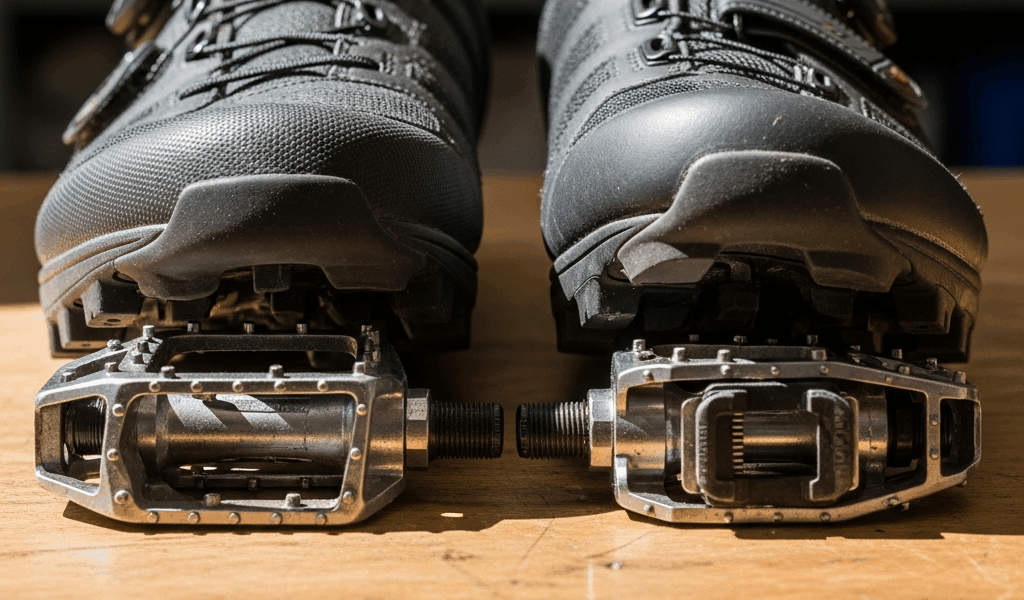
Best Mountain Bike Shoes — Flat Pedal vs Clipless Compared
Mountain bike shoe shopping has grown more complex with the “best of” roundups flying around. You’ll click through a dozen listicles, absorb zero useful information, and still not know whether you should be riding flat pedals or clipless. That decision — the system decision — matters more than any specific shoe on any specific list. Get it wrong and a $200 pair of shoes will fight you every single ride. I rode flat pedals for three years, switched to clipless for XC, then switched back to flats for enduro. Each time, the shoe choice was secondary. The system was everything.
Today, I will share it all with you. System call first, product picks second. No fence-sitting.
This article includes affiliate links. We may earn a commission at no extra cost to you.
Flat Pedal Shoes — When and Why
But what is a flat pedal shoe, really? In essence, it’s a shoe engineered to grip bare metal platform pedals through rubber chemistry alone — no mechanical attachment, no cleat, nothing locking your foot down. But it’s much more than that. The flat shoe is a whole philosophy about how your foot should interact with the bike.
That’s what makes flat pedals endearing to us trail riders. The control is immediate. Reactive. You can reposition mid-rock-garden without a second thought. Danny MacAskill runs flats. Most elite slopestyle and downhill racers run them. The “beginner shoe” framing has done serious damage to how people understand this category.
The defining feature isn’t stiffness. It isn’t the lacing system. It’s the rubber compound — full stop. Five Ten built their entire brand identity around Stealth rubber, engineered specifically to grip against metal pins on flat pedals. Stand on a pedal with Stealth under your foot and the shoe almost welds itself to the platform. No mechanism required. It’s tactile in a way that’s genuinely hard to describe until you’ve felt it.
Grip pattern matters almost as much as compound, though. A flat, featureless sole hydroplanes off a wet pedal regardless of rubber quality — the pins on your pedal need somewhere to sink. Hexagonal or diamond-patterned lugs with recessed channels between them create mechanical interlocking on top of the adhesive grip. Two things working together.
Sole stiffness in flat shoes is a genuine debate. Softer soles grip better — more rubber surface contacts the pedal. Stiffer soles reduce foot fatigue on longer rides and push power more efficiently. Most trail and park riders end up somewhere in the middle. Five Ten rates their soles on a stiffness scale — the Freerider series sits at a 7 out of 10, which has quietly become the de facto standard for all-mountain flat shoe feel.
Flat pedal shoes are best for beginners learning trail features, bike park riding, enduro, and downhill. They’re legitimately good for any rider who values confidence over pure efficiency. The learning curve is zero. You walk up to the bike, put your feet on the pedals, and ride.
Probably should have mentioned this earlier, honestly — I destroyed a pair of generic skate shoes on trail riding for about six months before anyone told me grip compound existed as a product category. Those shoes cost me real control without me even realizing it. Steer clear of where I went wrong.
Clipless Shoes — When and Why
Clipless shoes have gotten a reputation problem with all the confusing naming flying around. “Clipless” means you clip in. The name comes from the old toe-clip cage system it replaced — once those cages disappeared, the new system got called clipless, and the name stuck despite making zero logical sense. A cleat on the shoe bottom locks into a spring-loaded mechanism on the pedal. Unclipping requires a heel-twist outward. Twenty minutes to learn. Two weeks to make automatic.
Humbled by forgetting to unclip at a trailhead stop, I fell over in slow motion in front of four strangers during my first week with SPD pedals. That was embarrassing. Every single clipless rider has this story — it happens once or twice and then it stops happening entirely. Consider it an initiation.
So, without further ado, the actual performance case: efficiency on climbs. Your foot is mechanically coupled to the crank, so pulling up through the pedal stroke actually contributes power instead of your foot just sitting passively on a platform. On long XC rides — we’re talking two hours, three hours, 5,000-foot days — the difference in leg fatigue is measurable. Not marginal. Measurable.
Shimano SPD is the dominant mountain biking standard, and the reason is walkability. The two-bolt cleat recesses into the sole — you walk normally, no clacking on every hard floor like a road cyclist. SPD cleats run $15–$20 for a replacement pair, available at virtually every bike shop globally, and the design has been essentially unchanged for thirty years. Compatibility is never an issue.
Clipless shoes also tend to be stiffer through the midfoot — power goes into the pedal axle instead of disappearing into sole flex. For XC racers doing 5,000+ feet of climbing in a single event, that’s not a minor detail. It’s the difference between cramping out at mile 40 and finishing strong.
The trade-off is real, though. Emergency foot placement takes a fraction of a second longer. On technical descents, that hesitation has consequences. Most clipless mountain riders learn to pre-unclip before sections where a foot might need to come down — it becomes instinctive, but it takes time to develop.
Top 3 Shoes in Each Category
Flat Pedal Shoes
Five Ten Freerider — $100–$130: The benchmark. Stealth C4 rubber compound, a 7/10 stiffness rating on Five Ten’s own scale, and a silhouette that looks like a regular sneaker while performing like a purpose-built riding shoe. Available in low and mid-cut versions — the mid offers ankle coverage for rowdier terrain. The Freerider Pro adds a BOA dial closure at $150 if laces feel wrong for your riding style. If you’re buying one flat shoe and have no specific requirements, start here and stop looking.
Ride Concepts Livewire — $115: A strong challenger to Five Ten’s dominance. Ride Concepts developed a Vibram-licensed rubber compound specifically for pedal grip — nearly identical to Stealth in dry conditions and arguably better in wet. The Livewire has a slightly stiffer platform than the Freerider, fits wider feet more comfortably, and has a more aggressive outsole tread pattern that actually helps on hike-a-bike sections over loose terrain. I’m apparently a wide-foot person, and the Livewire fits me while the Freerider never quite did.
Shimano GR5 (SH-GR501) — $90: Overlooked because Shimano gets filed mentally under “clipless company.” That’s a mistake. The GR5 grips well, has a reinforced toe cap that survives actual rock strikes, and comes in at the lowest price point of the three. The sole runs slightly softer than the Freerider — better grip, but requires some adjustment if you’re coming from a stiffer platform. For budget-conscious riders, this shoe punches well above its price class.
Clipless Shoes
Shimano XC3 (SH-XC300) — $80–$100: The honest entry point for XC clipless. Two-bolt SPD compatible, stiffness index of 4 on Shimano’s 12-point scale — moderate, appropriate for trail riding rather than pure racing. Genuine lace closure with a secondary hook-and-loop strap at the ankle. Not the lightest shoe in the category. Not the stiffest. But it’s the shoe I’d hand to someone new to clipless systems — forgiving, comfortable to walk in, available in sizes 36–48. It does what it says without drama.
Giro Ranger — $150: Frustratingly hard to categorize, which is actually the point. The Ranger sits between XC efficiency and trail comfort — Rubber Guard toe protection, a Vibram MegaGrip outsole that performs genuinely well when you’re off the bike, and a Boa L6 dial plus lace closure combo. The Boa closes in under two seconds and never loosens mid-ride. This is the shoe I currently run for all-day trail missions. Stiffness is moderate — efficient enough on climbs, not so aggressive that it punishes your feet at hour five.
Five Ten Kestrel Lace — $155: Five Ten makes clipless shoes too — the Kestrel is their trail-oriented clipless option. Stealth rubber carries over to the outsole portions not occupied by the SPD cleat, which means real grip when walking and when dabbing feet on technical sections. Lace closure gives precise forefoot fit. Stiffness runs on the higher end for a trail shoe — rewards efficient pedaling, but may feel firm on genuinely long days. Best for riders who want clipless efficiency without completely abandoning ground feel.
The Verdict — Start Flat, Upgrade When Ready
Here is the direct take: start on flat pedals.
New to mountain biking? Flat pedal shoes teach foot position, weight distribution, and how to move on the bike — without the complication of being mechanically attached to the cranks. Trail features like drops, rock gardens, and switchbacks require reactive foot movement. Being able to reposition instantly — without thinking about unclipping — lets you focus on the trail instead of your feet. The Five Ten Freerider at around $110 is an honest, capable flat shoe that will survive two to three seasons of regular riding.
Intermediate riders putting in long XC miles, doing any racing, or regularly climbing more than 2,000 feet should seriously consider making the switch. The efficiency gain on sustained climbing is real. The Shimano XC3 at $90 or the Giro Ranger at $150 are both solid starting points. Budget an extra $40–$60 for Shimano SPD pedals alongside the shoes — the M520 or M540 are the standard choices, widely available, reasonably priced.
Enduro and downhill riders have legitimate arguments for both systems. Most gravity-oriented riders run flats — not because they’re beginners, but because explosive, reactive riding requires freedom of foot placement. Some enduro racers clip in on liaison stages and run flats for timed descents. A minority approach, but worth knowing it exists.
The false premise behind most mountain bike shoe searches is that there’s one best shoe. There isn’t. There’s a best system for your riding, and then there’s the best shoe within that system. Nail the system choice and almost any quality shoe in the $90–$160 range will serve you well. Get the system wrong and the best shoe in the world will frustrate you every time you hit the trail.
Flat pedals first. Clipless when you’re chasing efficiency. The shoes follow from there.

Stay in the loop
Get the latest pro bike tech updates delivered to your inbox.