As someone who has used every major power meter system across multiple bikes, I sat down and learned where you measure changes what you learn. Today, I will share it all with you.
This article includes affiliate links. We may earn a commission at no extra cost to you.
Power Meter Positioning: Where You Measure Changes What You Learn
Power meters have become essential training tools, but the location of measurement—crank spider, crank arm, or pedal—affects data accuracy, practicality, and the insights you can extract. Each position captures power at a different point in the drivetrain, with implications for both the numbers displayed and their training utility.
Crank-Based Power Meters: The Reference Standard

Crank spider power meters (Quarq, Power2Max, Shimano, SRAM AXS PM) measure at the interface between crankarm and chainrings.
How they work: Strain gauges bonded to the spider detect material deformation as torque is applied. Cadence is measured independently (accelerometer or magnet), and power is calculated from torque multiplied by angular velocity.
Advantages:
- Protected position—spider is inboard, less exposed to impact
- Measures total power before drivetrain losses
- No pedal system restrictions (use any pedals)
- Typically excellent accuracy (+/- 1.5% claimed by premium units)
- Dual-sided measurement standard (left/right balance)
Disadvantages:
- Not portable between bikes with different crank interfaces
- Installation requires crank removal (tools needed)
- Cold temperature affects strain gauge calibration
- Higher cost for quality units ($600-1,200)
Crank Arm Power Meters: Arm-Based Measurement
Crank arm power meters (Stages, 4iiii Precision) measure strain in the crankarm itself.
How they work: Strain gauges bonded to the inner surface of the crankarm detect arm deformation. Single-sided units measure one arm and double the value; dual-sided measure both arms independently.
Advantages:
- Lower cost for single-sided ($300-400)
- Light weight (adds 15-20 grams)
- Compatible with existing chainrings
- Easy installation—swap entire crankarm
Disadvantages:
- Single-sided versions assume 50/50 left/right balance (often inaccurate)
- Left-arm-only units miss right leg contribution variations
- Arm flex characteristics vary by manufacturer—accuracy affected by arm design
- More exposed to impact damage than spider units
The single-sided reality: Most riders have 48-52% left/right balance, but this varies by intensity, fatigue, and cadence. A rider with 47/53% balance sees 6% power discrepancy from a left-only power meter. For training zones, this may be acceptable; for racing or precise testing, it introduces noise.
Pedal-Based Power Meters: The Portable Option
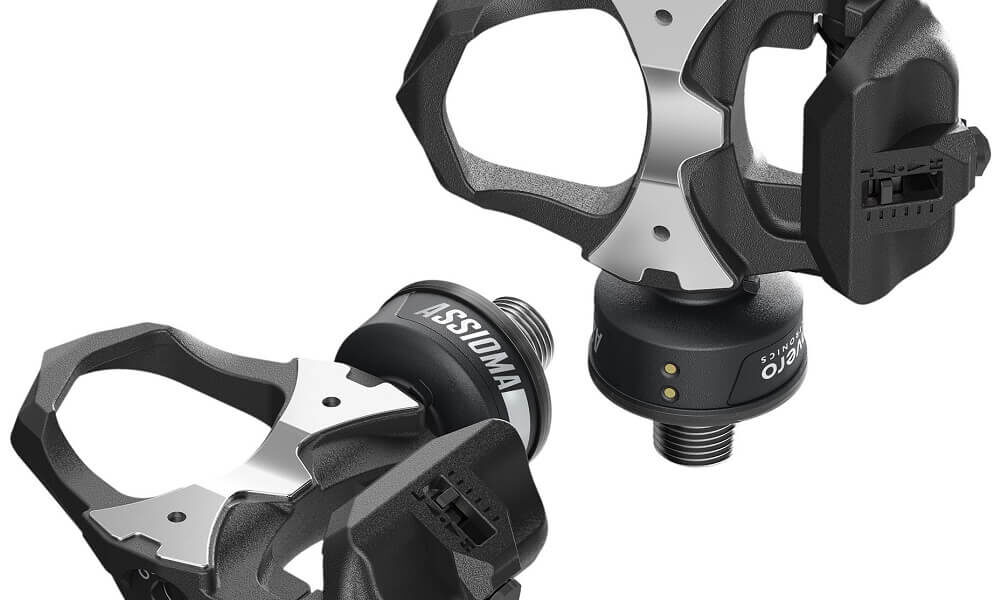
Pedal power meters (Garmin Rally, Favero Assioma, SRM X-Power) measure force at the pedal spindle or pedal body.
How they work: Strain gauges in the pedal spindle measure force vectors. Some systems measure tangential force only; premium systems capture total force vectors including wasted lateral forces.
Advantages:
- Swap between bikes in seconds
- Dual-sided measurement standard on most units
- No bike-specific compatibility issues
- Advanced pedaling dynamics available (power phase, platform center offset)
- Works on any crank/frame combination
Disadvantages:
- Locked into specific pedal system (Look, SPD-SL, SPD)
- Exposed position—vulnerable to crash damage
- Weight concentrated at rotating mass (increases rotating inertia)
- Spindle length may differ from non-power pedals (cleat position changes)
- Accuracy affected by improper installation torque
Accuracy Comparison
Independent testing reveals accuracy hierarchies, though results vary by unit and conditions:
- Premium spider-based (SRM, Quarq DZero, Power2Max NG): +/- 1.0-1.5%
- Premium pedal-based (Garmin Rally RS200, Favero Assioma Duo): +/- 1.0-2.0%
- Dual-sided crank arm (Stages LR, 4iiii Precision Pro): +/- 1.5-2.0%
- Single-sided crank arm: +/- 2-5% (depending on individual left/right balance)
The Left/Right Balance Question
Pedal and dual-sided crank power meters provide left/right balance data. The training utility is debated:
Useful applications:
- Identifying significant imbalances (greater than 55/45) warranting attention
- Tracking imbalance changes during injury recovery
- Correlating fatigue patterns with balance shifts
Limited utility:
- Attempting to “correct” moderate imbalances (often creates problems)
- Over-analyzing normal variation (balance shifts during rides are normal)
- Comparing balance across different power meters (measurement differences exist)
Practical Selection Criteria
Choose spider-based if:
- You ride primarily one bike
- Accuracy is paramount
- You want pedal choice flexibility
- Budget allows premium investment
Choose pedal-based if:
- You ride multiple bikes
- Quick bike swaps are needed (indoor trainer, different outdoor bikes)
- You’re committed to a specific pedal system
- You want pedaling dynamics data
Choose single-sided crank if:
- Budget is the primary constraint
- Training zone accuracy (rather than absolute accuracy) is sufficient
- You know your left/right balance is relatively even
Multi-Bike Strategy
Riders with multiple bikes face the consistency challenge. Options:
- Identical power meters on each bike: Highest cost, highest consistency
- Pedal power meter swapped between bikes: Lower cost, requires carrying spare pedals
- Primary power meter + virtual power on trainer: Acceptable for structured training if trainer is calibrated against outdoor meter
The Bottom Line
Power measurement location affects data quality, but training consistency matters more than absolute accuracy. A power meter you use consistently—calibrating properly, understanding its quirks—delivers more training value than a theoretically superior system you don’t trust or maintain.
Match the power meter position to your riding reality: how many bikes, which pedal system, what accuracy needs, and what budget constraints. Then train with the data you have, not the data you wish you had.

Stay in the loop
Get the latest pro bike tech updates delivered to your inbox.