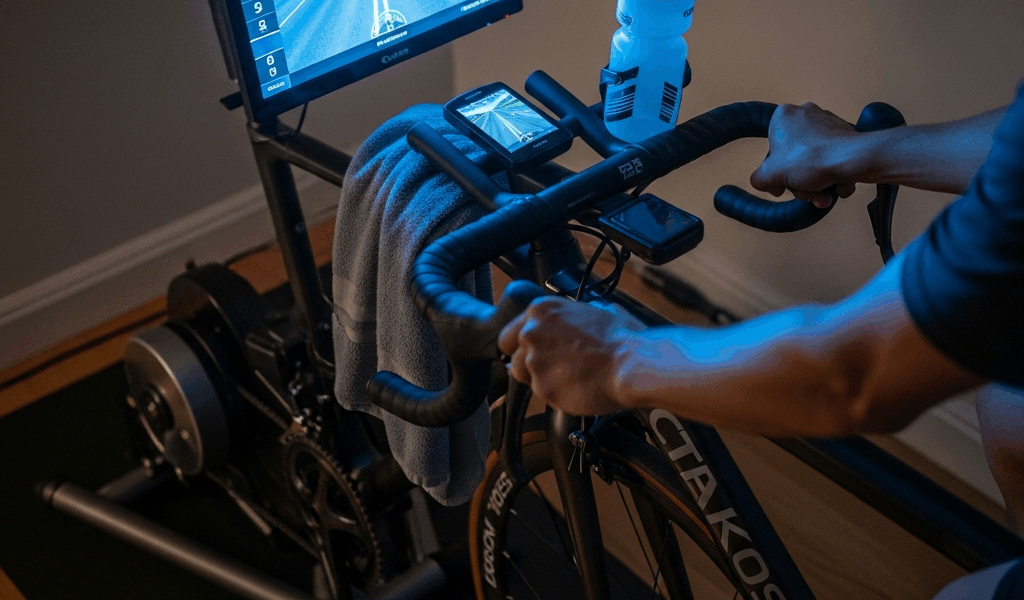
Three Apps, Three Philosophies
The Zwift vs Rouvy vs TrainerRoad comparison is one of the most genuinely confusing decisions a new indoor cyclist faces — and I say that as someone who spent three winters bouncing between all three apps before landing on what actually worked for me. Most comparison articles list features side by side like they’re reading from a spec sheet. That’s not useful. What’s useful is understanding that these three apps were built for completely different riders, with completely different goals, and picking the wrong one means you’ll either dread your trainer sessions or simply stop doing them.
Here’s the short version before we go deep. Zwift is a gamified virtual world with social rides and competitive racing. TrainerRoad is a clinical, no-frills structured training platform designed entirely around making you faster. Rouvy sits in between — it uses real video footage of actual roads, overlaid with augmented reality elements, so you feel like you’re pedaling through Mallorca or up Alpe d’Huez without leaving your garage in Ohio.
Three distinct apps. Three distinct riders. The goal of this article isn’t to crown a winner. It’s to help you figure out which rider you are.
They’re also not all the same price, and that matters. As of 2024, Zwift runs $19.99/month. TrainerRoad is $19.99/month as well, but there’s an annual plan at $189.95 that drops the effective monthly cost. Rouvy is cheaper — $10/month on the annual plan, or $15/month if you pay monthly. So if budget is tight, Rouvy is the easiest entry point. But don’t let price alone drive this. The wrong app at $10/month is still wasted money if you stop logging in after two weeks.
If You Want to Race and Socialize — Zwift
Zwift launched in 2015 and it changed indoor cycling in a way that’s hard to overstate. Before Zwift, riding a trainer was a solitary, genuinely miserable experience. You set up in front of a television, watched a cycling DVD or a Netflix show, and stared at a wall for an hour. Zwift replaced the wall with Watopia — a fictional island with beaches, volcanos, cobblestone climbs, and thousands of other riders you can actually interact with.
Probably should have opened with this section, honestly, because Zwift is where most people start. It’s the name everyone recognizes. And there are good reasons for that.
The community is enormous. On any given Tuesday evening you can join a group ride with 500 people from 30 countries. There are sanctioned races every hour of the day, ranging from beginner Cat D events to serious Cat A racing that attracts former professionals. The Zwift Racing League is a real thing, with teams and seasons and results that people track obsessively. If competition is what keeps you pedaling, Zwift delivers that in a way the other two apps simply cannot match.
The virtual worlds have expanded significantly since launch. Beyond Watopia, there’s Makuri Islands, New York, London, France, Innsbruck, and a handful of event-only maps. Each world has multiple routes, climbs, and sprint segments called KOMs and Sprints where you can compete against every rider who’s ever ridden that road. Setting a PR on the Alpe du Zwift — a 12.2 km virtual climb modeled loosely on Alpe d’Huez — feels surprisingly satisfying. More satisfying than it probably should, but there it is.
Zwift offers a 14-day free trial, which is long enough to genuinely evaluate whether the format clicks for you. You’ll need a compatible smart trainer (anything from a $200 wheel-on like the Tacx Flow to a $1,200+ direct drive like the Wahoo KICKR Core) and a device to run the app — PC, Mac, iPad, Apple TV 4K, or Android tablet. Note that Apple TV limits you to Bluetooth connections and has a three-device pairing cap, which can be annoying if you’re using a heart rate monitor, power pedals, and a trainer simultaneously.
The honest drawback to Zwift is the one nobody wants to say out loud — it can become a game more than training. I made this mistake in my first winter using it. I would join group rides, mess around chasing riders, do random routes based on whatever looked fun, and at the end of three months I had logged a lot of hours but hadn’t gotten meaningfully faster. Zwift has structured workout mode and training plans built in, but the temptation to abandon them the moment a group ride appears on screen is real. If you have the discipline to follow a plan inside Zwift, great. Most people don’t.
Who Should Choose Zwift
- Riders who struggle with motivation and need external engagement to stay consistent
- People who miss the social element of group riding during winter months
- Competitive riders who want to race regularly without traveling to events
- Anyone who wants their indoor sessions to feel less like suffering in a room
If You Want to Get Faster — TrainerRoad
TrainerRoad is not pretty. There’s no avatar. No virtual world. No other riders to chase. You open the app, the workout loads, colored blocks appear on a screen telling you what power to hold for what duration, and you do it. That’s the entire visual experience. If you’ve ever said the words “I just want to get faster, I don’t need the bells and whistles,” TrainerRoad is probably where you should be.
Founded in 2012 and based in Reno, Nevada, TrainerRoad was built by cyclists who were frustrated that indoor training had no real structure or science behind it. The app now has hundreds of structured workouts and full training plans organized by discipline — road, mountain bike, triathlon, cyclocross — and by time commitment, ranging from low-volume plans of about 3.5 hours per week up to high-volume plans pushing 10-plus hours. Every workout is designed around specific physiological targets: VO2max, threshold, sweet spot, endurance, and sprint.
The feature that separates TrainerRoad from everything else is Adaptive Training. Launched in 2021 after years of development, Adaptive Training uses machine learning to monitor how you’re actually responding to your workouts and adjusts future sessions in real time. Struggled with Tuesday’s VO2max intervals? Adaptive Training notes that, recalibrates your progression levels, and modifies your Thursday workout accordingly. Crushed it easily? It makes things harder. The system is genuinely responsive in a way that static training plans simply aren’t.
Dragged into structured training by a cycling coach friend who handed me a printed 8-week plan and a post-it note that said “just do the work,” I eventually migrated everything to TrainerRoad when I realized I needed accountability and adaptability built into the software itself rather than having to call a human every time life disrupted my schedule. My FTP — functional threshold power, the rough benchmark for cycling fitness — went from 241 watts to 278 watts over one 16-week Sweet Spot Base to Sustained Power Build progression. That’s a 15% gain. I’ve never gotten close to that with any other approach.
TrainerRoad does not offer a free trial. This is a legitimate criticism. You can access a 30-day money-back guarantee, but you have to pay first. At $19.99/month or $189.95/year (about $15.83/month effectively), it’s comparable in price to Zwift. The TrainerRoad podcast — called “The Ask a Cycling Coach Podcast” — is free and extraordinarily detailed if you want to evaluate their philosophy before paying.
One more thing worth saying clearly: TrainerRoad works best when you pair it with your own entertainment. Most serious TrainerRoad users have a tablet propped up showing a race replay on GCN+, a podcast playing, or a TV episode running in the background. You supply the engagement. The app supplies the structure. Some people love this separation. Others find it miserable.
Who Should Choose TrainerRoad
- Riders with a specific event on the calendar — a gran fondo, a race, an Ironman — who need to peak for a date
- Data-driven athletes who want to understand exactly why each workout exists
- People who’ve done Zwift for a season and enjoyed it but didn’t make the fitness gains they expected
- Cyclists who already have entertainment habits and don’t need a virtual world to stay focused
If You Want Beautiful Routes — Rouvy
Rouvy is the app that most cyclists haven’t heard of but probably should know about. It was founded in the Czech Republic in 2013 (originally under the name CycleOps Virtual Training before becoming an independent platform) and it does something genuinely different from both Zwift and TrainerRoad: it puts you inside real video footage of real roads, with an AR overlay showing your avatar moving through the actual environment.
Riding Rouvy’s video of the Col du Tourmalet is a different experience from riding a virtual fantasy mountain in Zwift. The road surface, the hairpin turns, the actual gradients filmed on location — it feels more like a simulation and less like a game. For riders who are training for a specific real-world climb or event, this is genuinely valuable. You can preview exactly what the road looks like, learn where the steepest sections hit, and pace yourself accordingly.
The route library is substantial — over 5,000 real-world routes across more than 160 countries. Famous climbs covered include Mont Ventoux, the Strade Bianche gravel roads, Passo dello Stelvio, and various Tour de France and Vuelta a España stages. You can also import a GPX file from Strava or Komoot and ride a custom route with elevation data and a basic visual environment, though the custom route experience isn’t quite as polished as the filmed routes.
Group rides and challenges exist in Rouvy, though the community is smaller than Zwift’s. Expect to find group rides, but not the constant volume of events Zwift offers. Rouvy added AR avatars a few years ago so other riders appear in the real video footage alongside you, which is a clever implementation even if it occasionally looks slightly uncanny.
Rouvy’s 7-day free trial is shorter than Zwift’s 14-day offer, but it’s enough to evaluate the video quality and see whether the format resonates. The app runs on iOS, Android, Apple TV, and PC. At $10/month on the annual plan, it’s the most affordable of the three — and for a rider whose primary goal is exploring routes and riding iconic roads, it delivers the most value per dollar.
The weakness is training structure. Rouvy has workout plans, but they’re nowhere near as sophisticated as TrainerRoad’s Adaptive Training. If performance gains are your primary metric, Rouvy won’t get you there as efficiently. It’s a beautiful tool for what it is — a way to make indoor riding feel connected to real geography. It’s not trying to be a training platform in the same clinical sense.
Who Should Choose Rouvy
- Cyclists training for a specific real-world event who want to preview the course
- Riders who are motivated by scenery and find virtual cartoon worlds slightly absurd
- Budget-conscious cyclists who want a polished experience at the lowest monthly cost
- Travelers and gravel riders who love exploring geography from the saddle
The Verdict — Match Your Goal
Here’s the framework. Stop comparing features and start with a single honest question: why am I riding indoors?
If the answer is something like “I want to stay motivated, I miss the social side of cycling, and I’d actually like to race a little without getting up at 5 a.m. and driving to a crit” — that’s Zwift. Pay the $19.99/month, use the 14-day free trial first, and lean into the community. Follow one of Zwift’s built-in plans if you want structure, and resist the urge to abandon every workout when a fun group ride notification pops up.
If the answer is “I have a specific goal — a race, a time, a power number — and I want to do whatever it actually takes to hit it” — that’s TrainerRoad. Accept that the interface is boring, bring your own entertainment, and trust the process. The Adaptive Training system is the most sophisticated thing in consumer cycling software right now. Use it properly for 12 to 16 weeks and you’ll see the results.
If the answer is “I want to explore the world from my garage, I love the idea of climbing famous roads, and I’m not obsessive about FTP numbers” — that’s Rouvy. Start the 7-day trial, search for a climb you’ve dreamed about riding, and see whether that format makes you excited to get on the trainer.
One last honest note: you don’t have to commit forever. I’ve run Zwift and TrainerRoad simultaneously during particularly motivated winters — using TrainerRoad for my structured workouts and jumping into Zwift on recovery days or weekends when I wanted company. At a combined $40/month that’s real money, but it’s cheaper than a gym membership and cheaper than buying a second bike. The apps aren’t mutually exclusive.
But if you’re choosing one? Three apps, three riders. Figure out which rider you are first. The right app follows from that, and it becomes obvious fast.




Stay in the loop
Get the latest pro bike tech updates delivered to your inbox.