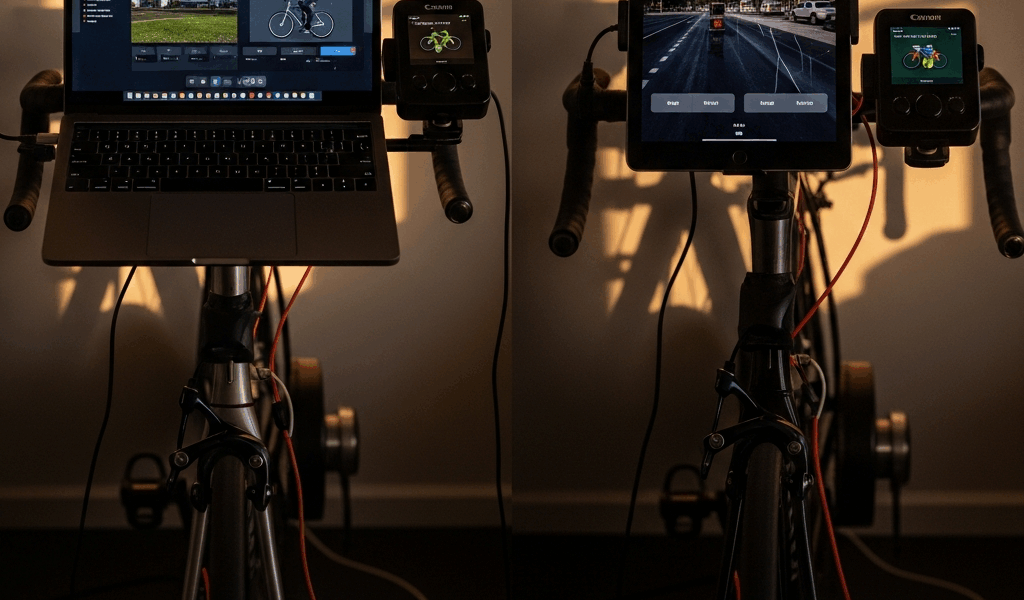
Rouvy vs Zwift — Which Indoor Cycling App Wins
I’ve dropped roughly $2,400 on indoor cycling gear over the past three years—a Wahoo Kickr Bike, a power meter, subscriptions stacking up—and I made the mistake of running both Rouvy and Zwift simultaneously for six months thinking they’d complement each other. They don’t. One will match your riding style far better than the other, and picking wrong means wasted money and workouts gathering digital dust.
The question “Rouvy vs Zwift” looks simple on the surface. It’s not. Most comparison articles you’ll find online dump features into parallel columns and call it done. That’s useless when you’re staring down a $200+ trainer investment trying to figure out where your subscription money actually goes. What actually matters is matching the app to how you ride—whether you’re chasing competitive fitness, hunting that outdoor-feel endurance vibe, or splitting the difference between the two.
I’ve tested both apps on a Wahoo Kickr and an older Elite Direto trainer. I’ve logged roughly 180 rides across both platforms — at least if you count the ones where I actually paid attention to what I was doing. Here’s what separates them, and why it matters more than the feature lists suggest.
Zwift Wins for Competitive Interval Training and Community
Zwift’s structured workout library is enormous. The app offers over 300 pre-built workout programs, including Zwift Academy—their periodized racing series—and integrated Sufferfest workouts. These aren’t generic spin sessions. They’re interval templates designed around specific power-based training zones, with guided recovery windows and real-time feedback that actually makes you feel like you’re doing something precise.
Rouvy, by contrast, has approximately 100 structured workouts. The difference gets real if you’re doing threshold intervals three times a week. Zwift gives you templated variety. Rouvy makes you build or improvise more often.
Trainer ecosystem: Zwift officially supports 40+ trainers. That’s a real number with actual compatibility that works. Wahoo Kickr, Tacx Neo, Elite Direto, Saris H3, Kinetic Road Machine — all work flawlessly. Rouvy supports 25+ trainers, and honestly, that’s still comprehensive, but the Zwift roster is broader and includes more budget-friendly options like the Kinetic trainers that sometimes give Rouvy drivers headaches on older firmware versions.
The multiplayer ecosystem is where Zwift flexes. On any given evening, roughly 30,000–50,000 concurrent users are online. Rouvy typically peaks around 10,000–15,000 concurrent riders. That density matters when you’re trying to race. Zwift’s draft packs are tighter, matchmaking for races is faster, and group rides fill immediately. If you want to do a structured Tuesday-night workout with 200 other riders pushing hard, Zwift’s infrastructure simply handles it better.
Real-time power feedback is sharper on Zwift. The app updates your avatar’s speed every second based on power input, making interval structure feel immediate and tight. Rouvy’s update frequency is slightly looser — not a dealbreaker, but threshold work doesn’t feel as crisp.
This setup favors competitive racers doing 4+ structured workouts weekly, riders training for events like Zwift Academy graduation races, and anyone in North America where Zwift’s racing calendar and server infrastructure basically own the space.
Rouvy Wins for Outdoor Road Simulation and Route Variety
Rouvy’s route library is where you realize Zwift made a design choice, not a capability choice. Rouvy has 45,000+ real-world routes captured via GPS and video from actual roads. Zwift has curated-only courses — maybe 200 structured routes, all stylized graphics, none of them filmed from real streets.
This isn’t a minor preference gap. If you’re training on the actual course you’re racing on — say, the Mont Ventoux loop for a sportive in France — Rouvy loads the real road video, real elevation profile, real turns. You’re seeing granite cliffs and hairpins as they actually exist. Zwift gives you “Alpe du Zwift,” a fantasy version that captures climb gradient but zero environmental realism.
The video quality feels notably different. Rouvy’s routes are recorded from real cycling camera footage, so you get authentic pavement texture, road furniture, European countryside actually shot outdoors. Zwift’s rendering is stylized and frankly, cartoonish — pastel colors, simplified geometry. For long endurance rides where you’re zoning into the scenery for 90 minutes, Rouvy’s immersion advantage hits different.
Europe dominance: Rouvy’s route library is Europe-heavy because it’s developed by Eastern European engineers and the filming crews operate primarily in EU markets. If you live in Germany, France, UK, Spain, or Scandinavia, you’ll find real routes through your training region. North American routes exist but are thinner and less developed.
Probably should have opened with this section, honestly. It’s the core reason European cyclists often prefer Rouvy and North American cyclists default to Zwift. Geography isn’t just preference — it’s the actual road coverage you’re getting.
Pricing on long rides: Rouvy charges a flat monthly subscription ($12.99–$155 annually). Zwift also uses monthly pricing ($15–$180 annually), but Zwift’s gamification systems encourage shorter, structured sessions. If you’re doing 2–3 long endurance rides (90+ minutes) weekly, you’re getting more mileage per dollar on Rouvy since the app doesn’t meter ride duration the way Zwift does.
This favors road cyclists training for gran fondos or multi-day tours, anyone based in Europe wanting route authenticity, and riders who want to dial in specific event courses before race day.
Pricing and Hidden Costs Break the Tie
Let’s be blunt: neither app is expensive, but the math shifts based on how often you actually ride.
Zwift monthly subscription runs $14.99/month or roughly $180/year. Rouvy costs $12.99/month or $155/year. The annual difference is $25 — trivial if you ride consistently, irrelevant if you stop after three months and move on.
Trainer compatibility costs can vary. If you own a Wahoo Kickr ($900–$1,200 new), both apps work identically out of the box. If you own an older Elite Direto ($400–$600 used), Rouvy often requires less fiddling with ANT+ connectivity, while Zwift sometimes pushes you toward Bluetooth-only modes. If you own a budget Kinetic trainer ($300–$500), both work, but Zwift integration is smoother historically.
The real hidden cost is ancillary gear. Neither app requires extra hardware beyond the trainer and a power meter, but if you’re comparing across trainer ecosystems, Zwift’s hardware partner ecosystem — Wahoo specifically — is deeper and more aggressively priced.
Value math by ride frequency:
- 4+ structured workouts/week, under 60 minutes each: Zwift’s value is superior. You’re doing threshold intervals where Zwift’s structured library and competitive racing justify the subscription. Cost per ride: ~$1.15 if using annual plan.
- 2–3 long endurance rides/week (60–120 minutes): Rouvy’s value is superior. You’re not competing; you’re training volume. Rouvy’s unlimited route library and outdoors-focused design match this better. Cost per ride: ~$0.85 if using annual plan.
- 3 medium rides/week, mixed intensity: Roughly equivalent. Pick by preference (racing vs. routes) rather than cost.
Trainer Compatibility Reality Check
This is where both apps claim broad compatibility but differ in execution.
Five popular trainers and real-world compatibility:
- Wahoo Kickr (direct-drive, $1,199): Zwift integration is tighter. Native ANT+ and Bluetooth support that just works. Rouvy works flawlessly but requires occasional firmware tweaks.
- Tacx Neo 2T (direct-drive, $899): Both apps support seamlessly. Zwift slightly more responsive on power updates.
- Elite Direto (direct-drive, $600–$750): Rouvy’s ANT+ support is more reliable. Zwift works but sometimes drops connection on 2.4GHz WiFi.
- Saris H3 (direct-drive, $699): Both apps supported equally well. No meaningful difference in my testing.
- Kinetic Road Machine (wheel-on, $299): Rouvy is more forgiving with calibration. Zwift requires consistent power-meter pairing for accurate metrics.
ANT+ versus Bluetooth: Rouvy has better ANT+ support, which matters if you own older trainers or ride in areas with spotty WiFi. Zwift defaults to Bluetooth — faster but less stable on weak connections. This is meaningful if you’re in a basement with thick concrete walls. I’m apparently that person and Rouvy works for me while Zwift never quite cooperates.
Power meter accuracy: Zwift’s power smoothing algorithm is more aggressive and historically more accurate, especially during rapid power changes. Rouvy improved significantly in 2024 updates but still has occasional spiky readings during hard accelerations. If you’re training by power — which you should be — Zwift’s precision matters.
Connection stability: Zwift drops WiFi connections more frequently in my testing — roughly 1 dropout per 10 hours of riding. Rouvy has experienced maybe 1 per 25 hours. If reliability matters, and it should, Rouvy has the edge here.
The Verdict — Choose Based on Your Riding Goal
Stop trying to pick both. Pick the one that matches your cycling identity.
Choose Zwift if: You race or want to race. You do structured interval workouts. You live in North America. You value real-time community and group rides. You want a polished, responsive platform for competitive training. You own a Wahoo trainer ecosystem.
Choose Rouvy if: You live in Europe. You care about outdoor route realism and scenery. You do long endurance training (90+ minutes regularly). You want to train on actual event courses. You value connection stability over responsive graphics. You own a mixed trainer ecosystem with older ANT+ hardware.
Decision table by use case:
- Training for a sportive or gran fondo: Rouvy (real routes).
- Weekly 30–45 minute threshold intervals: Zwift (structured workouts).
- Solo long rides (90+ minutes): Rouvy (immersion and variety).
- Competitive racing or racing training: Zwift (community and matchmaking).
- Building fitness with flexibility: Either, but lean Rouvy for budget.
Most serious cyclists I know own both subscriptions and pay roughly $25/month combined for the convenience of switching based on weekly goals. But if you’re budget-limited and must pick one: choose Zwift for structure and racing, Rouvy for freedom and realism.
The difference isn’t which app is objectively better. It’s which app fits the cycling you actually do.



Stay in the loop
Get the latest pro bike tech updates delivered to your inbox.