Why Your Chain Skips Under Load But Not at Rest
Drivetrain diagnostics have gotten less clear-cut with all the conflicting advice flying around. As someone who has rebuilt more drivetrains than I can honestly count — including one very humbling two-hour session where I blamed a perfectly fine derailleur hanger for what turned out to be a completely destroyed chain — I’ve picked up the practical knowledge of load-specific chain skip. Today, I will share it all with you.
So, without further ado, let’s dive in.
But what is load-specific skipping? In essence, it’s when your chain jumps teeth during hard pedaling but behaves perfectly when the drivetrain is relaxed. But it’s much more than that. It’s a symptom that points to specific worn components — and knowing which ones to suspect first saves you real money.
Here’s the thing most riders miss. Worn teeth on a chain or cassette can look almost normal when nothing’s happening. No tension, no problem. The moment you push serious power through them, the geometry fails. The chain rides up over rounded or hooked teeth instead of seating. That’s what makes load-specific skipping so maddening — it hides from you until the worst possible moment.
The diagnostic approach is straightforward: start with what wears fastest and costs the least to replace, then work outward toward the expensive stuff. Chain first. Cassette second. Derailleur hanger, cable tension, jockey wheels after that. In that order, every time.
Step 1 — Check Chain Wear First
A worn chain is the most common cause of load-specific skipping. It’s also the cheapest fix on the list — which is exactly why you check it first.
You’ll need a chain checker tool. While you won’t need anything fancy, you will need a reliable measuring tool like the Park Tool CC-3.2, which runs about $10 at most shops and takes maybe 30 seconds to use. Drop it onto your chain while it’s sitting on the smallest chainring with no tension applied. The tool gives you two critical readings: 0.5% wear and 0.75% wear.
Here’s what those numbers actually mean:
- At 0.5%: The chain is tired but still functional alongside a fresh cassette. If you’re already skipping, the cassette has probably caught up in the wear race.
- At 0.75%: Replace the chain immediately. At this point it’s been quietly destroying your cassette for weeks. Skipping will accelerate fast.
- Beyond 0.75%: The chain is done. Non-negotiable replacement — and budget for a new cassette too, because you’ll almost certainly need one.
No chain checker handy? The pull-away test works in a pinch. Grab the chain on the smallest chainring and pull outward from the teeth. A healthy chain barely budges. A worn one pulls away a quarter-inch or more. Crude, but it tells you what you need to know.
Steer clear of where I went wrong. I replaced my chain on a bike that had been skipping, felt great about it, and two weeks later the skipping came back just as bad. Turned out I’d let the old chain run long enough to hook the cassette teeth underneath. Replaced the chain without checking the cassette. Spent money twice. I’m apparently someone who learns lessons the expensive way, and that Park Tool CC-3.2 works for me now while guessing never does.
Step 2 — Inspect the Cassette for Shark Fin Teeth
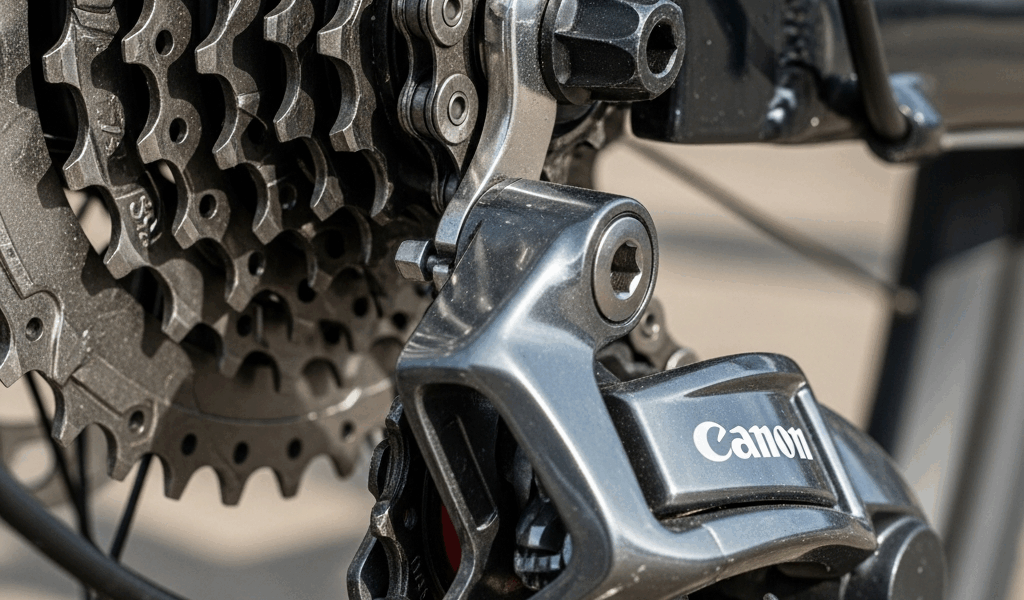
Cassette wear has a very specific look once you know what you’re after. Shift to your smallest cog and examine the teeth under bright light — natural sunlight works better than a shop lamp, honestly. A worn cassette develops what mechanics call “shark fin” teeth. The leading edge curves backward like a breaking wave. One side of each tooth looks shiny and polished. The other looks dull and rough. The asymmetry is obvious once you’ve seen it once.
Skipping tends to attack the hardest-used cogs first. Sprinters burn through the smallest cogs. Climbers who grind middle gears tend to see wear cluster there instead. Check the gears you actually live in.
The repair decision follows directly from your chain measurement. If your chain read under 0.5% wear and the cassette teeth look sharp and symmetrical, leave the cassette alone. Don’t replace it. But if your chain measured 0.75% or worse — go ahead and order a cassette now. It absorbed all that chain stretch and it’s damaged.
There’s an awkward middle case worth knowing about. Chain at 0.5%, cassette showing mild hooking but nothing dramatic. Replace the chain first, then ride hard for a week and retest. A fresh chain sometimes meshes just well enough with a lightly worn cassette that the skipping stops entirely. Sometimes. Worth trying before spending $40 to $80 on a new cassette.
Step 3 — Check Derailleur Hanger Alignment and Cable Tension
Worth mentioning before anything else — a bent hanger disguises itself so convincingly that riders spend weeks chasing chain and cassette problems that aren’t actually there.
Frustrated by misalignment that’s invisible to the naked eye, many mechanics have developed a two-millimeter rule: even two millimeters of hanger bend is enough to push the derailleur slightly away from the cassette under load. The chain can’t mesh cleanly. Skip. That’s the whole failure chain in one sentence.
Start with a visual check. Shift to the smallest cog and crouch behind the bike to sight along the derailleur cage. It should run parallel to the cassette face. If it looks canted outward at all, suspect the hanger immediately.
For a real measurement, the Park Tool DAG-2.2 costs around $40 and clamps directly onto the hanger. The indicator arm sweeps around and references the cassette. Any movement in that indicator means the hanger is bent — either straighten it or replace it. Hangers are cheap, usually $10 to $20, and are designed to be sacrificial. That’s their whole job.
Once the hanger is sorted, move to cable tension. The barrel adjuster on the derailleur body controls the cable’s resting position. Turn it counterclockwise to add tension, clockwise to release. Half-turn increments only — this is not a coarse adjustment. Too much tension and the derailleur can’t shift properly. Too little and it hunts between cogs under pedaling load, which feels exactly like a worn drivetrain skip.
Dial it in like this: shift to the smallest cog, listen for chain rub against the derailleur cage, aim for zero. Then shift to the largest cog and repeat. Rub at either extreme means you’re off by half a turn somewhere. This whole process is free and — in my experience — resolves roughly 40% of skipping complaints before you ever touch a new part.
Step 4 — Eliminating Jockey Wheel Wear and Limit Screw Issues
Worn jockey wheels introduce side-to-side slop in the derailleur cage. That play prevents the chain from seating consistently on cassette teeth. Under load, the cage wobbles. The chain skips. Simple as that.
Grab the derailleur cage with one hand and shake it. A healthy derailleur barely moves. A worn one clicks with noticeable lateral play. Replacement jockey wheels run $15 to $30 depending on the brand and take about 10 minutes to swap. That’s a cheap fix for what feels like a serious problem.
The B-screw — the small adjustment screw that controls the derailleur’s distance from the cassette — is worth checking next. If the gap between the upper jockey wheel and the smallest cassette cog exceeds roughly 5 millimeters, the chain is sitting too far back to grip properly under load. Measure that gap visually or with a ruler, then turn the B-screw clockwise to bring the derailleur closer. Small adjustments only. A quarter-turn changes things meaningfully.
Once everything is adjusted or replaced, go ride hard. This new setup needs real-world validation — accelerate aggressively through multiple gears, find a steep climb and push a sustained effort, sprint out of a corner. A repair stand tells you almost nothing. Load reveals everything.
Skipping that survives this full sequence is genuinely rare. But if yours does, you’ve now ruled out every common variable with your own hands — and you can walk into any bike shop knowing exactly what’s already been eliminated.



Stay in the loop
Get the latest pro bike tech updates delivered to your inbox.