Why Your Disc Brakes Are Rubbing
Disc brake troubleshooting has started getting harder to follow with all the conflicting advice flying around. As someone who spent three genuinely embarrassing years chasing the wrong fix on a rubbing rear brake, I picked up the practical knowledge of hydraulic disc brakes rubbing — how to stop it, how to diagnose it, and how to avoid the rabbit holes that waste your whole afternoon. Today, I will share it all with you.
Here’s the thing nobody tells you upfront: the rub sounds identical to your ears no matter what’s causing it. But the fix depends entirely on which of three root causes created it. Caliper misalignment. Rotor warp. Contaminated or glazed pads. Most guides treat each one in isolation — so you fix the first thing, the brake still rubs, and now you’re guessing blind. That’s what makes a proper diagnostic flow so valuable to us riders who’d rather be on the trail than in the garage.
Before you touch a single tool, just listen. A constant, rhythmic rub whether you’re braking or coasting? Caliper misalignment or a warped rotor — almost every time. An intermittent rub that shows up only under hard braking? Glazed pads or light contamination. A rub that appeared right after you lubed your chain or washed the bike? That’s contamination. Full stop. This one step alone saves hours.
So, without further ado, let’s dive in.
Fix 1 — Realign the Caliper
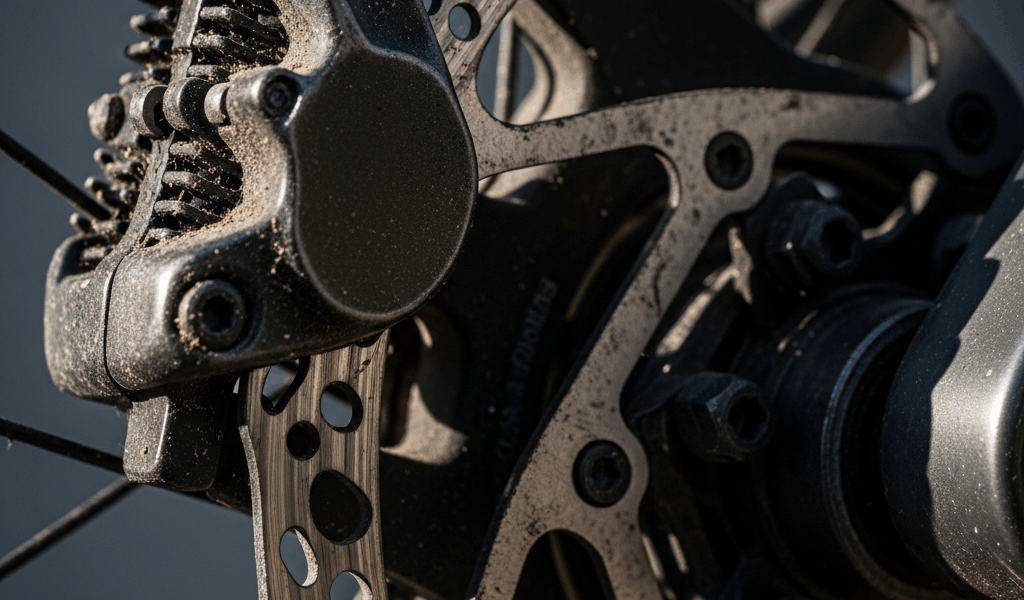
Caliper misalignment causes more rubbing complaints than anything else. Probably because a caliper drifting sideways after a rough descent or a minor crash is almost invisible — you can’t feel it happened.
Here’s the process. Loosen both caliper mounting bolts — the two that attach the caliper body to the frame or fork — until the caliper rocks side to side freely. Don’t remove them completely. Just loose enough to move. Now squeeze and hold the brake lever hard. Keep holding it. While you’re maintaining full pressure on that lever, tighten both bolts back down. Release the lever. Spin the wheel slowly and check the gap between pad and rotor on both sides.
The gap should look even. If you can clearly see the pad kissing one side of the rotor while sitting nearly half an inch away on the other — that’s your problem right there.
Most riders make the same mistake I did early on. They tighten one bolt, then the other, then check alignment. Save yourself the trouble I had. The caliper drifts the second that first bolt goes snug. Both bolts tighten while the lever is held, or the whole thing resets itself crooked. Every time.
If the caliper keeps drifting back to misalignment after several attempts, suspect two things. Your frame or fork threads might be stripped — common after crashes or years of overtightening. Or the adapter face, the flat surface where the caliper mounting bracket sits, isn’t actually flat anymore. A warped adapter can sometimes be cleaned up with a file and a flat reference surface. Stripped threads, though? That usually means a new adapter or a shop visit. Rare, but it happens more than people admit.
Fix 2 — Straighten or Replace a Warped Rotor
Bent rotors create a constant drag that caliper adjustment simply cannot fix — because the rotor itself is the problem, and no amount of fiddling with bolt positions changes that.
Isolate the warp before you decide whether to fix or replace. Spin the wheel slowly while holding a fixed reference point close to the rotor edge without touching it. Your fingertip works. A zip tie clipped to the frame works even better. Watch for the moment the rotor swings away from your reference point. Mark that high spot with a marker, or wrap a small zip tie around the nearest spoke at that exact location. Now you have something to aim at.
Small warps — less than a millimeter of movement when you spin the wheel — respond well to a rotor truing tool. These run $12 to $25 and take maybe five minutes to learn. Clamp the rotor, spin the wheel, and gently bend it back toward center. Work slowly. One or two small adjustments per pass, not one dramatic correction.
For tiny bends, I’ve had real success with the careful-hands method. Lay a clean rag on a flat surface, set the rotor on top, and use gentle pressure plus light taps from a plastic mallet to work the high spot back down. This takes patience — and it absolutely ruins the rotor if you rush.
Here’s the part worth saying first. Know when a rotor is too far gone. If the rub returns within a single ride after truing, the rotor has structural fatigue. Replace it. If you can see a visible kink, or the warp measures more than 2–3 millimeters, replace it. Cheap rotors — the $20 ones — warp faster than quality rotors, especially on heavier riders or in hot climates. I’m apparently a heavier rider in a hot climate, and a Shimano RT-MT800 at around $50 works for me while the no-name rotors I tried never lasted a full season.
Fix 3 — Deal With Contaminated or Glazed Pads
Contaminated pads almost always need replacing. But what is contamination, exactly? In essence, it’s oil, chain lube, or any hydrocarbon that’s soaked into the pad material. But it’s much more than surface-level grime — once it’s in, it’s in. I’ve tried cleaning contaminated pads multiple times and regretted every single attempt.
Glazed pads are a different animal. Glazing happens when pads overheat and the surface hardens into a slick layer — gripless, uneven, and prone to that specific high-pitched squeal under braking. They rub because they’re not engaging the rotor consistently across the full contact surface.
For glazed pads, 120–180 grit sandpaper on a flat surface does the job. Sand the pad face lightly in small circles until the shiny glaze disappears and fresh material shows underneath. Don’t go aggressive here. Changing the pad shape defeats the whole purpose. Light passes only. This usually revives glazed pads enough to stop the rub entirely.
Clean the rotor after any pad work. Isopropyl alcohol — 70% or higher — and a clean rag only. Spray brake cleaner near the wheel and you risk overspray drifting into hub bearings or the rear derailleur. Isopropyl dries fast, leaves no residue, and won’t harm anything nearby. One or two passes with a well-soaked rag handles it.
If the rub appeared right after washing your bike or lubing your chain, contamination is the culprit — not alignment. Contamination migrates from rotor to pads in seconds if the application goes even slightly wide.
Still Rubbing After All That — Check These Last
Less common causes trip up riders every week. Worth running through these before assuming something worse:
- Quick release or thru-axle not fully seated. A loose axle lets the rotor sit off-center inside the caliper. Close the quick release properly or torque the thru-axle to spec — usually 6–10 N⋅m depending on the system. Spin the wheel and listen again.
- Hub bearing play. Grab the wheel at the rim and try to move it side to side, perpendicular to the axle. Any play at all means loose bearings, which wobble the rotor inside the caliper on every rotation. Adjust cone wrenches or replace the cartridge bearing depending on your hub type.
- Post-mount adapter face not flat. A warped rotor mounting surface means the rotor never sits centered, regardless of what else you adjust. A bike shop can face the adapter with proper equipment — it’s typically a $15–$30 service. Not a DIY fix, at least not without a proper facing tool.
One last detail worth knowing. If the rub is intermittent and only appears under heavy braking or when you’re leaning hard into a turn, suspect frame flex or bearing play — not caliper alignment. A perfectly aligned caliper at rest and a perfectly aligned caliper under load are two entirely different situations. That distinction matters.
Spin the wheel, listen carefully, follow the diagnostic flow. You’ll find the fix without burning an afternoon on the wrong problem.

Stay in the loop
Get the latest pro bike tech updates delivered to your inbox.