Dropper Post Won’t Return to Full Height — Here’s the Fix
This article includes affiliate links. We may earn a commission at no extra cost to you.
Dropper posts have become tricky with all the hydraulic remotes, wireless actuators, and proprietary internals flying around. As someone who’s been wrenching on mountain bikes for about twelve years, I spent real time learning the ins and outs of dropper troubleshooting — mostly through panicked texts from riding buddies at trailheads. “It’s just kind of… sagging.” Or the classic: “Goes down fine but only comes back up halfway.” The symptoms vary wildly. The diagnosis process, though, is actually pretty logical once you know where to look. This guide breaks everything down by dropper type, because a RockShox Reverb has almost nothing in common with a OneUp V3 when it comes to figuring out what went wrong.
The 60-Second Fix Most Riders Miss
Here’s the part worth saying first — it solves the problem roughly 40% of the time and requires less effort than hunting down your hex keys.
Check your seatpost clamp. Not a casual glance. Actually loosen it, pull the post to full extension by hand, then re-torque to 4–5 Nm. That’s the whole fix.
Here’s what’s happening: an overtightened seat collar squeezes the outer stanchion hard enough that the air spring or return mechanism can’t generate enough force to push through it. The dropper strains against that clamped resistance, stalls somewhere around 80% height, and sits there looking broken — when it isn’t broken at all.
Skip past the mistake I made. I did exactly this with a brand-new PNW Cascade on a Trek Remedy — spent a solid twenty minutes convinced the post was defective straight out of the box. A friend suggested loosening the collar almost as a joke. Torque spec called for 4 Nm. My clamp was sitting at what I’d estimate was closer to 8 Nm, tightened on pure instinct. Grabbed an actual torque wrench, hit the spec, and the post snapped up like nothing had ever been wrong. Twenty minutes of frustration for a two-minute fix.
A few specifics worth knowing here:
- Use a torque wrench — not feel, not a guess. A basic EPAuto 1/4-inch drive bicycle torque wrench set runs about $25 and pays for itself the first time you use it.
- 4–5 Nm covers most aluminum and carbon seat tube clamps on dropper posts.
- If your frame runs a single-bolt collar, verify the bolt isn’t cross-threaded. A stripped clamp won’t hold proper torque — it’ll land either too loose or too tight, with no usable middle ground.
- Wipe the post stanchion with a dry rag before re-torquing. Dried mud or old lube on the outside of the post adds friction between the post and the collar.
Run through this before touching anything else. Everything below assumes you’ve already done it.
Air Spring Droppers — Check and Set Pressure
Air spring droppers — the Fox Transfer, RockShox Reverb AXS, OneUp V3, and similar designs — rely on a sealed air chamber to push the post back up when you release the lever. But what is an air spring dropper, really? In essence, it’s a post with a pressurized chamber doing the work of a physical coil spring. But it’s much more than that — the pressure has to be dialed precisely to your weight, or the return force just isn’t there. Low chamber pressure means the post returns sluggishly, stalls partway up, or barely moves at all. This is the second most common reason a dropper won’t fully extend.
You’ll need a shock pump with a Schrader valve fitting. Most air dropper posts put the valve either under the saddle — you pull the saddle and seat clamp hardware to reach it — or at the base near the bottom bracket. Fox Transfer posts run the valve at the bottom. OneUp’s V3 puts it at the top, accessible after pulling the saddle rails from the head.
Pressure Ranges by Rider Weight
These are general starting points. Specific models often publish tighter windows in their manuals, so treat these as your baseline:
- Under 130 lbs — 150 to 175 PSI
- 130–160 lbs — 175 to 200 PSI
- 160–190 lbs — 200 to 225 PSI
- 190–220 lbs — 225 to 250 PSI
- Over 220 lbs — 250 to 300 PSI
Fox’s Transfer calls for 150–300 PSI depending on rider weight — Fox publishes a chart matching weight to PSI in 25-pound increments in their setup guide. The Reverb AXS targets a similar window. OneUp’s V3 is built around a slightly lower baseline, with roughly 150 PSI recommended for lighter riders as a starting point.
How to Check and Add Air
Attach the shock pump, read the current pressure, compare it to the chart. If you’re sitting at 120 PSI and you weigh 185 pounds — that’s your problem, right there. Add air in 10 PSI increments and test the return speed after each one. You want a fast, confident snap upward — not a lazy crawl.
Frustrated by a slow air leak I couldn’t track down on my Transfer, I eventually found the valve core itself had worked loose. A valve core tool — under $5 at any bike shop — lets you tighten or swap it out. Worth checking before you assume the post needs a full service.
One thing people consistently miss: don’t check pressure while sitting on the bike. The post needs to be at full extension, completely unweighted. Reading pressure while seated compresses the air spring and gives you a falsely low number.
Cable-Actuated Droppers — Tension and Routing
Cable-actuated droppers — the PNW Rainier, Brand-X Ascend, older Gravity Dropper models — work on a different principle entirely. A mechanical cable opens a valve that allows the post to travel. The return force comes from an internal coil spring or air chamber, but the cable’s only job is triggering the release mechanism. It doesn’t lift the post itself.
That’s what makes cable-actuated designs endearing to us budget-conscious riders — fewer things can go catastrophically wrong. When these posts fail to return to full height, though, cable tension is almost always the first place to look.
Barrel Adjuster — The Quick Tune
Your lever has a barrel adjuster where the cable housing seats into it. A mushy, incomplete return usually means the cable has stretched slightly or the housing has compressed a bit — both are normal over time. Turn the barrel adjuster counterclockwise, outward, in half-turn increments. You’re adding tension, which ensures the valve mechanism opens completely when you press the lever.
The Brand-X Ascend II is apparently more sensitive to cable tension than most posts. Brand-X’s own setup documentation recommends leaving about 2–3mm of free play at the lever before the cable goes taut. Too much tension and the valve never fully closes — leaving the post in a sort of half-engaged limbo. Too little and the valve never opens completely, which explains the sluggish return.
Test after every half-turn. Over-tensioning is a genuine problem — don’t crank the barrel adjuster all the way out at once.
Internal Routing Kinks
Internal cable routing is convenient right up until it isn’t. A kinked cable housing inside the frame creates friction that stops the cable from moving freely. The post might drop down just fine — gravity helps — but the return spring can’t overcome the cable friction on the way back up.
PNW’s Rainier installation guide specifically warns about routing the cable through sharp bends near the bottom bracket. On frames with tight routing ports, the housing can kink right at the entry point — exactly where you can’t see it.
Here’s the test: disconnect the cable at the lever and pull it by hand. It should slide smoothly with almost no resistance. Any stickiness or grinding sensation means you have a routing problem. Options are re-routing with fresh cable and housing, or running a PTFE-lined housing — Jagwire’s Pro housing works well here — to cut friction through tight bends.
Replace cable and housing together. Running a new cable through old housing wastes your time — the housing is usually the degraded part anyway.
Hydraulic Droppers — When to Bleed vs Replace
The RockShox Reverb is the most common hydraulic dropper out there, and it generates more repair questions than any other post I deal with. The original Reverb ran a hydraulic remote system that needed periodic bleeding — and when the bleed degraded or air crept into the system, the post got weird in predictable ways: slow return, partial extension, travel that felt inconsistent from one drop to the next.
Signs You Need a Bleed
The Reverb is telling you it needs a bleed when:
- The lever feels spongy or needs excessive travel before the post responds
- The post returns slowly and inconsistently rather than uniformly sluggish
- The post drops on its own while you’re seated — this is a bleed issue, not a spring issue
- You haven’t serviced it in over a year of regular riding
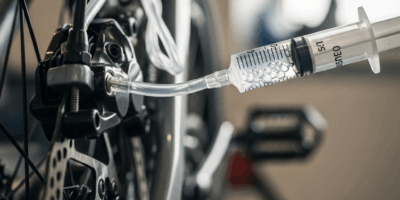
RockShox’s Reverb bleed procedure uses Reverb Bleed Fluid — a specific mineral oil formulation, not DOT fluid. Do not substitute. The procedure calls for a bleed kit with two syringes, which RockShox sells as the Bleeding Edge Bleed Kit for around $35. It’s a legitimate DIY job if you’re comfortable working with hydraulic systems. Budget about 45 minutes the first time through.
When to Replace the Cartridge Instead
If you’ve bled the Reverb twice and the same symptoms persist — or if you’re seeing oil weeping from the post body — the internal cartridge is probably worn out. Replacement cartridges for the original Reverb run about $80–$120 depending on travel length, with a shop charging another $40–$80 in labor on top of parts.
At that price point, run the numbers honestly against a new cable-actuated post. A Brand-X Ascend II goes for around $90. A OneUp V3 runs $199. If your Reverb is five or more years old and needs both a cartridge and a bleed, the repair math sometimes just doesn’t favor fixing it — especially since newer cable-actuated posts have eliminated the hydraulic remote complexity entirely.
The Reverb AXS is a different situation. That post is worth repairing because replacement runs $450 or more. For the original wired Reverb, though — run the numbers before committing to a full service.
When the Spring Is Actually Dead
Every dropper post — air-assisted, cable-actuated, or hydraulic — has some form of return spring. On many posts it’s a physical coil. On others it’s an integrated air chamber doing double duty as the spring. These springs wear out. Not usually in the first two or three years, but at four or five years of hard use, a weakened spring produces the exact symptom you’re dealing with: post won’t return to full height, or climbs halfway and quits.
Identifying a Worn Spring
The signature of a dead or dying return spring is consistent, repeatable partial return — not random, not weather-dependent, but identical every single time. Post goes down, you release the lever, it climbs to 60% and stops. Every time. That consistency is what separates a spring problem from a pressure or cable issue, which tend to behave more erratically.
Pull the post off the bike and actuate it by hand. Full extension should feel fast and firm. If you can push the post up with one finger and it moves without real resistance, the spring has lost its force.
Replacement Availability by Brand
This is where things get brand-specific:
- Fox Transfer — Fox sells an IFP service kit that addresses return spring issues, running about $40–$50 through Fox’s service parts portal. Full instructions are in Fox’s service manual, freely available on their site.
- OneUp V3 — OneUp sells a complete internals rebuild kit for around $45, with a solid YouTube service tutorial to go with it. Probably the most DIY-friendly post on the market right now.
- PNW Rainier — PNW sells a full rebuild kit including the coil spring for $30. Their customer service is genuinely excellent — they’ll walk you through the process over email if you get stuck.
- Gravity Dropper — Springs are available directly from Gravity Dropper for under $15. The post’s entire design philosophy is field serviceability, so replacement is about as straightforward as it gets.
- Brand-X Ascend — Parts availability is thin here. Wiggle and Chain Reaction stock some service parts, but a dead spring on an Ascend often becomes a replacement-post conversation given the low original purchase price of around $90.
DIY vs Shop Cost Comparison
For most spring replacements, DIY cost lands at $30–$50 in parts and roughly an hour of your time. A shop adds $50–$90 in labor on top of parts. If the post itself cost $100, a $130 repair bill at a shop is genuinely hard to justify. Do it yourself — watch the manufacturer’s YouTube tutorial, buy the correct rebuild kit straight from the brand, and skip the generic third-party kits, which often use lower-quality spring materials that wear out faster than stock.
The one exception: carbon seat tube frames. Some carbon frames have tolerances tight enough that improper post installation damages the tube itself. If you’re on a high-end carbon full-suspension bike and not fully confident in the reassembly, the $80 in labor is worth it. Frame repair costs considerably more.
One final thing: if you’ve worked through every step here — re-torqued the clamp, set correct air pressure, adjusted cable tension, confirmed clean routing, bled the hydraulics, inspected the spring — and the post still won’t return to full height, the post body itself has probably developed wear at the upper or lower bushing. At that point you’re looking at a full factory service or replacement. Most droppers give you a solid three to five years before reaching that stage with basic maintenance. The ones that die early almost always do so because one of the fixes above got ignored for too long.

Stay in the loop
Get the latest pro bike tech updates delivered to your inbox.