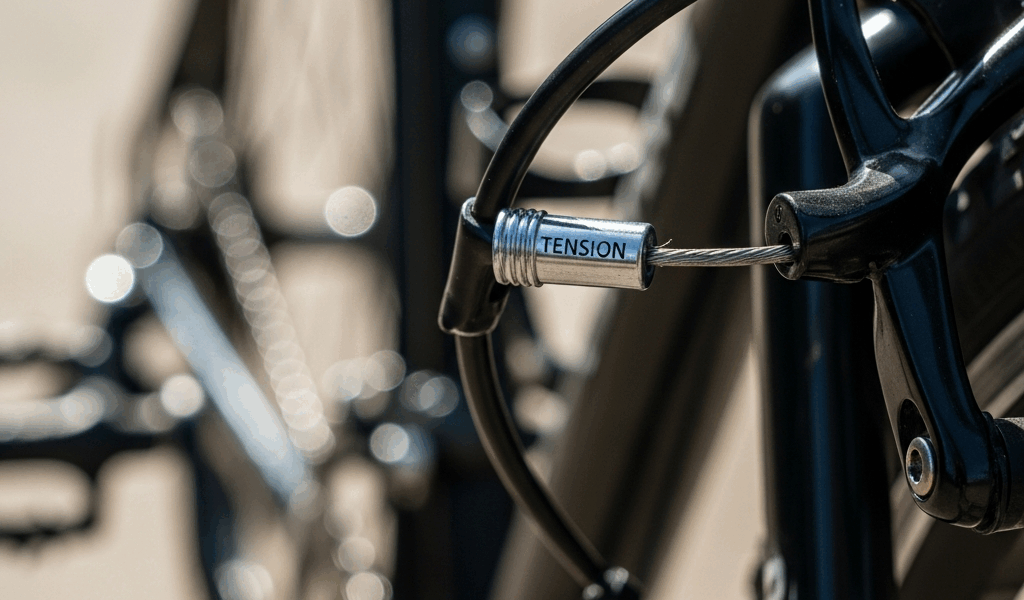
How to Tell If Cable Tension Is the Real Problem
Bike shifting has evolved with all the conflicting advice flying around. Last summer, I typed “shifter cable tension too high or too low fix it” into my phone at 6am after my Shimano 105 groupset started behaving like something was genuinely wrong with it — mid-ride, on a Tuesday, nowhere near my garage. Chain wouldn’t climb to the big ring. Then it dropped two gears on its own across a completely flat section. I was done.
But before you touch that barrel adjuster, you need to confirm cable tension is actually what you’re dealing with. I’ve burned an embarrassing amount of time chasing tension when the real culprit was a bent derailleur hanger hiding three millimeters of misalignment. Avoid the path I took.
Watch for these specific symptoms:
- Chain hesitates moving toward harder gears but shifts quickly the opposite direction
- Shifter lever has slack — you click it but the derailleur doesn’t respond immediately
- Chain drops past your intended gear and settles one or two cogs lower
- Shifting works fine at a standstill but skips randomly when pedaling under load
- Ghost shifting occurs — chain moves without you touching the lever
Now separate cable tension from the other usual suspects. A bent derailleur hanger creates rubbing or skipping that persists across all gears — jerky, not slow. A worn cable that’s fraying inside the housing makes the lever itself harder to pull, not just unresponsive. Kinked or compressed housing feels mushy no matter how aggressively you dial the adjuster. These are different problems with different fixes.
Grab a derailleur hanger alignment tool — or just use your eyes. Shift to the smallest cog and check whether the guide pulley sits directly below that cog in a clean vertical line. Angled outward or inward? That’s the hanger. Not tension.
Once the hanger checks out and the cable moves freely at the lever, tension is almost certainly your answer. So, without further ado, let’s dive in.
Too Little Tension — Chain Slow to Shift to Harder Gears
Quick note before the rest of this. Low tension is the most common problem I see, and it’s the easiest to fix.
It shows up as hesitation when you’re trying to shift into harder gears. The chain gets there eventually — there’s just a lag. On the rear derailleur, you’ll click the shifter and the cage takes a half-second to follow. On the front, the chain sits between rings instead of snapping cleanly onto the bigger one. You feel it before you can explain it.
Find your barrel adjuster. On most bikes it’s the threaded collar where the cable housing enters the derailleur body — usually a ribbed plastic or aluminum cylinder you can spin by hand. Some cable runs go under the bottom bracket, and on those frames you might adjust from the shifter end instead. Either works fine. For low tension, you’re turning counter-clockwise in quarter-turn increments.
Here’s the method I use every time:
- Shift to the smallest cog (rear) or smallest ring (front) by hand
- Turn the barrel adjuster counter-clockwise exactly one quarter turn
- Pedal gently and click the shifter once — test the response
- If hesitation remains, repeat steps 2 and 3
- Stop when the shift is crisp but not overshifting
The quarter-turn method matters more than it sounds. Full rotations are too coarse, especially on Shimano indexing — you’ll overshoot the fix and create the opposite problem. I learned this by turning the adjuster a full rotation once and spending twenty minutes carefully walking it back. Quarter turns only.
After three or four adjustments, test under actual riding conditions. Find a flat stretch and click through the entire cassette. Each shift should happen instantly — no lag, no pause, chain snapping into place the moment you click.
I’m apparently sensitive to even minor lever feel, and Shimano’s 105 shifters work for me while SRAM never quite felt right — so take your own tactile feedback seriously here. Five full rotations of the barrel adjuster and still getting hesitation? The cable itself is probably the issue. Check where the inner cable exits the shifter lever. Fraying visible there, or a stiff sticky feel when you pull manually? The cable has stretched or corroded inside the housing. A new Shimano inner cable runs about $8 to $12, and the swap takes maybe fifteen minutes.
Too Much Tension — Chain Overshoots or Ghost Shifts
High cable tension flips the problem. The chain moves too far — you click once and it overshoots, landing a cog or two higher than you wanted. Or it ghost shifts on its own, especially under load when frame vibration travels through the drivetrain. That one gets in your head fast.
This one feels worse than it is. Same fix, just reversed.
Turn the barrel adjuster clockwise in quarter-turn increments. Same protocol: smallest cog, one adjustment, pedal and test, repeat. You’re hunting for that exact tension point where shifts are instant and precise — no overshoot, no delay.
Ghost shifting under load deserves a second look, though. Tension can cause it, but so can deteriorating cable housing. Squeeze the outer housing between your fingers — if it compresses instead of staying rigid, the internal spiral wrap is breaking down. The housing can no longer support the cable under load, and vibration moves the derailleur involuntarily.
Also check the end caps where housing enters the derailleur body. Cracked plastic caps, or caps that no longer seat squarely, will produce the same ghost-shift symptom. These cost maybe $2 each — worth swapping while you’re already in there.
I had a SRAM Force groupset ghost shift for weeks before I finally spotted a compressed housing section under the chainstay that had kinked. Felt stupid once I found it. That was 2021, and no amount of barrel adjusting ever would have fixed it.
Resetting Cable Tension From Scratch the Right Way
When indexing is so far off that quarter turns aren’t making a dent, reset the whole baseline. This is the move after a crash, after someone else worked on your bike, or whenever you genuinely don’t know where you’re starting from.
Loosen the cable anchor bolt where the inner cable clamps to the derailleur. On Shimano rear derailleurs, that’s typically a 4mm Allen bolt on the cable attachment block. On SRAM, you’re looking at a similar bolt on the cage body. Don’t remove it completely — just loose enough to slide the cable freely.
Back the barrel adjuster nearly all the way out, leaving just a thread or two of engagement. That sets you to near-zero tension as a starting point.
Shift to the smallest cog or ring by hand. Pull the inner cable taut with your fingers — not cranked down hard, just hand-tight, removing all slack. Re-clamp the anchor bolt at that position. This gives you a clean, consistent baseline every single time instead of guessing at some unknown middle ground.
Now dial clockwise in quarter turns until indexing cleans up. You’re building tension up from a known-good starting point rather than adjusting blind.
One visual check worth doing here: the guide pulley should align directly below the smallest cog in a vertical line once you’ve clamped at hand-tight tension. Still angled wrong at that point? Your hanger is bent. Stop. Address that first before touching anything else.
When Barrel Adjusting Is Not Enough
But what is the actual limit of barrel adjustment? In essence, it’s a fine-tuning tool — not a rescue tool. But it’s much more than that if you use it correctly from a clean baseline. A full rotation in either direction with no improvement means the cable itself needs replacing.
Same conclusion if the shifter lever feels stiff or sticky even after lubricating the lever pivot. Visible fraying at the cable end where it enters the shifter? Replace it. A cable that’s kinked inside the housing? Replace it. Housing that crunches when you squeeze it? New housing — and usually a new cable to match, since you’re already doing the labor.
That’s what makes methodical diagnosis endearing to us mechanics — knowing exactly where the problem stops and the equipment starts. A quality Shimano inner cable runs $12 to $18. Pre-cut housing kits with ferrules and end caps run $25 to $40 for a complete set. Shimano cables and housing might be the best option, as cable tension correction requires consistent support across the full run — and Shimano’s housing maintains internal integrity longer than most generic alternatives.
You’ve got the diagnostic logic and the fixes now. Start with the symptom checklist, confirm it’s actually tension, and dial it in methodically. Quarter turns. Every time.

Stay in the loop
Get the latest pro bike tech updates delivered to your inbox.